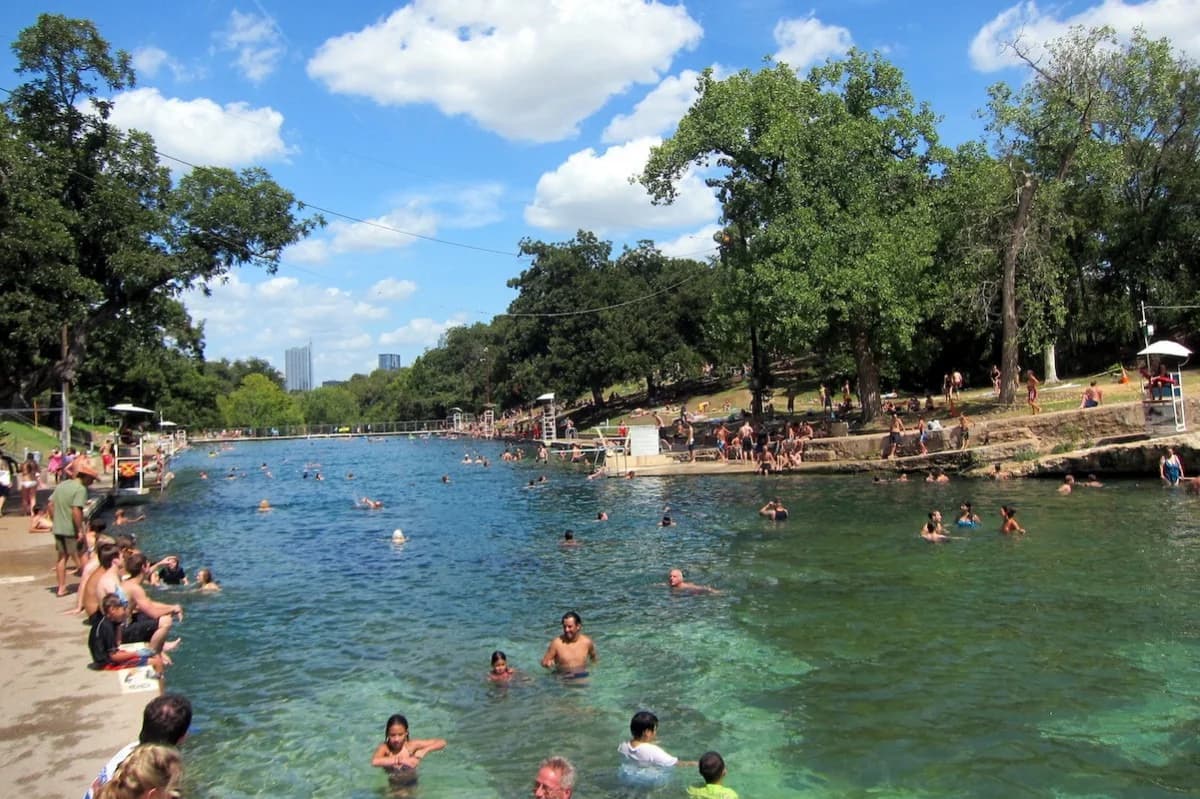
The city page lists daily hours except Thursday cleaning closures; the pool closes at or below 32F.[1]
A spring-fed, year-round swimming hole in Zilker Park that stays cool in summer and chilly in winter.
 South Africa TOSAC & Spotify annual #1 singles (2018–2026)15 views MusicJohannesburg
 South Korea Circle Digital Chart year-end #1 singles (2017–2026)14 views MusicSeoul
 Italy FIMI Top of the Music year-end #1 singles (2017–2026)12 views MusicMilano
 Gen.G Is Favoured Over Bilibili Gaming in the Worlds 2026 Grand Final on November 1412 views GamingBrooklyn
 Taiwan KKBOX Mandarin Yearly Singles #1s (2017–2026)11 views MusicTaipei City
 Germany GfK Top 100 Singles year-end #1s (2017–2026)11 views MusicBaden-Baden
 Japan Billboard Japan Hot 100 year-end #1 singles (2017–2026)10 views MusicTokyo
 France SNEP Top Singles year-end #1s (2017–2026)10 views MusicNeuilly-sur-Seine
 KFC Japan's 2027 Kenta Lucky Bag Lottery Opens November 13 at ¥3,90010 views FoodYokohama
 Cursor Comes to JetBrains IDEs14 views+150% AISan Francisco
 Sweden Sverigetopplistan year-end #1 singles (2017–2025)9 views MusicStockholm
 United Kingdom Official Singles Chart year-end #1s (2017–2026)9 views MusicLondon
 The Game Awards 2026 Reveals Its Nominees Live on November 17 GamingLos Angeles
 UFC 334 at Madison Square Garden: Kalshi Prices Gane at 68% Over Hokit in the Heavyweight Title FightLive market odds SportsNew York
 NICE to Cut About 500 Jobs Worldwide, 5% of Its Workforce LabourRa'anana
 World Happiness Report 2027: Traders Expect Finland on Top Again When the Rankings PublishLive market odds ScienceOxford
 Toronto's 122nd Original Santa Claus Parade Takes a New Route Down Yonge Street FestivalToronto
 Heidi Health Cuts 18% of Its Global Staff, At Least 108 Roles, as Two Cofounders Step Back LabourMelbourne
Virginia HB 897 requires data centers to use emission-free (non-diesel) backup generators and demonstrate commitment to clean energy to qualify for sales and use tax exemptions. The bill passed the House 61-34 and passed the full Senate, making Virginia one of the first states to condition data center tax incentives on environmental performance. Governor Spanberger signed HB 897 into law on April 9, 2026, alongside HB 284/SB 371 (voluntary demand flexibility programs for high-load customers using 25+ MW) and bills to aid low-income utility customers affected by data center energy demand.
Virginia SB 619 / HB 155 requires a State Corporation Commission certificate before data centers over 90 MW can operate. The SCC issues a certificate only if the facility has no material adverse effect on other customers' rates, reliability, or the utility's ability to meet Virginia Clean Economy Act goals. This represents one of the strongest state-level data center permitting requirements in the country.


Georgia SB34 would have prohibited data center fuel generation and transmission costs from being included in residential electricity rates, requiring commercial data centers to cover all increased fuel, power, and transmission system upgrade costs. The bill emerged after the Public Service Commission authorized Georgia Power to expand production by nearly 10 GW — mostly for data centers — including new methane-burning facilities. The Senate avoided a final vote after a last-minute alternative measure based on House Bill 1063 appeared to have the votes to pass.
WV House Bill 2014 (2025) created a certified microgrid program and set policies for data centers, stripping local government jurisdiction over 'high-impact' data centers (90+ MW) and diverting property tax revenue. In 2026, bills to restore local control (HB 5590, HB 5620) and require water usage disclosure were introduced but blocked. HB 4983 passed 78-16, bundling rulemaking to limit transparency. On April 1, 2026, West Virginia Watch published a call for a state moratorium, noting HB 2014 bans local governments from enforcing noise, pollution, zoning, lighting, viewshed, or land use rules against certified data center projects. Sen. Joey Garcia's bill to restore local control has not received a hearing. WV MetroNews published an April 7 analysis of the 'data center development dilemma.'

Washington State SB 6231 repeals the retail sales and use tax exemption for refurbishment of existing computer data centers. The law makes purchases of replacement server equipment ineligible for exemption. It preserves tax benefits for new data centers in rural counties where the economic incentive is more needed. The repeal is part of a broader push to rein in data center tax breaks.







 Berkshire Hathaway


 BYD Company