- Google released Gemini 4 Neon on 18 November 2026, a model in the Gemini 4 family that sits between Gemini 4 Carbon, built for the hardest long-horizon projects, and Gemini 4 Hydrogen, built for fast everyday execution.[1]
- Google pitches Neon as frontier-level reasoning that is faster and cheaper per task, aimed at complex, high-frequency coding, analytical and enterprise workflows.[1]
- It rolls out the same day in the Gemini API (paid tier) through Google AI Studio and Android Studio, in Gemini for business, in Google Antigravity and the Gemini app for Pro and Ultra subscribers.[1]
- A cyber variant, Gemini 4 Neon for cyber, goes to trusted defenders through the Fairwind Program, with access by contacting the Cloud account team.[1]
Notable features
- Pricing is $3 per million input tokens, $0.15 per million cached input tokens (a 95% discount) and $15 per million output tokens, with a 1 million-token context window.[1]
- It takes spreadsheets, PDFs, charts, audio and video as inputs in one context. It has four thinking levels, with "high" as the default and "xhigh" as the top.[1]
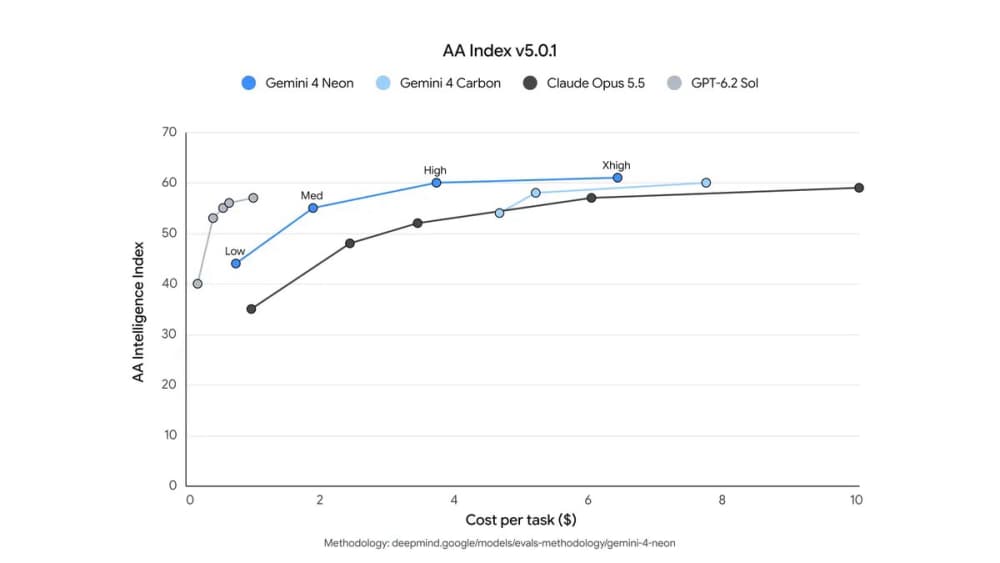
- Google cites Artificial Analysis Intelligence Index 61 at xhigh (third overall), second on the Vals Index at 70.9% and second on the Arena Agent Arena Index at 1336. These are Google's reported results, not independently checked here.[1]
- On coding and agents Google reports 70.5% on Terminal-Bench Science, 65.2% on Terminal-Bench 4.1 and first place on the Artificial Analysis Coding Agent Index at 58.6.[1]
- On cyber it reports 90.5% on SEC-bench Pro and a 0.0% attack success rate on Gray Swan IPI at the highest thinking level.[1]
Benchmarks
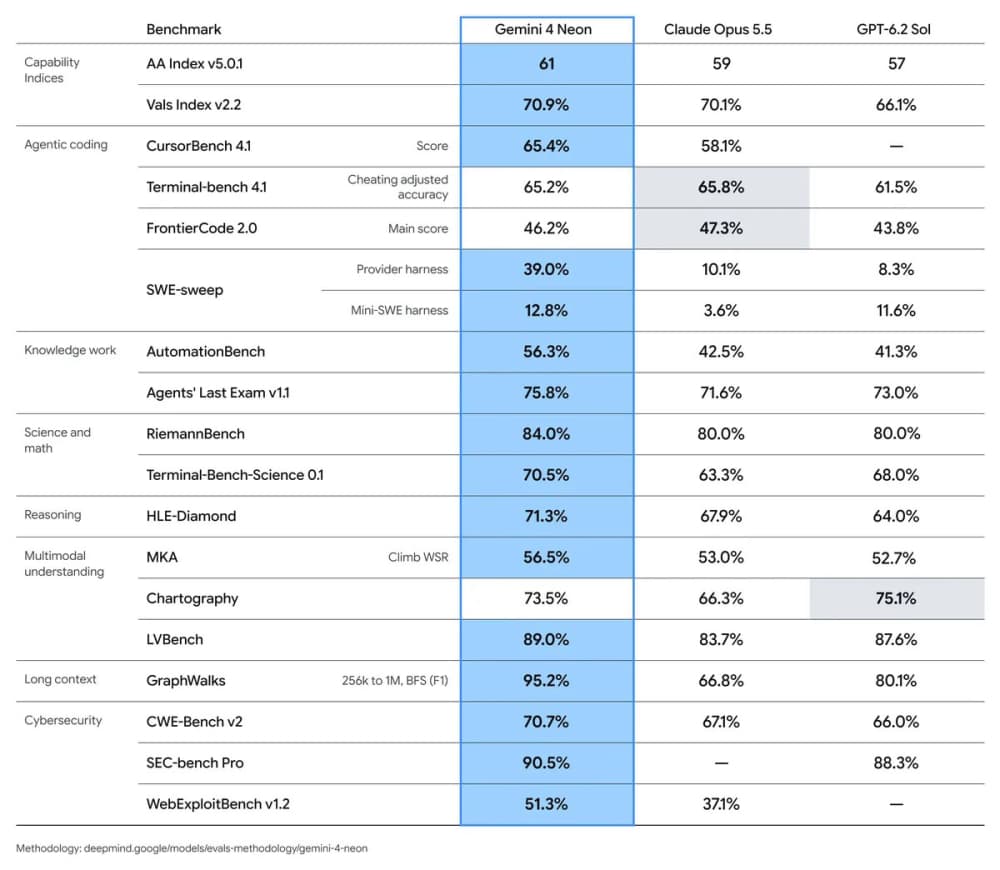
Google-reported launch comparison against Claude Opus 5.5 and GPT-6.2 Sol. A dash means Google published no figure for that model. These are the maker's own results, not independently checked here.[1]
| Benchmark (area) | Gemini 4 Neon | Claude Opus 5.5 | GPT-6.2 Sol |
|---|
| AA Index v5.0.1 (Capability indices) | 61 | 59 | 57 |
|---|
| Vals Index v2.2 (Capability indices) | 70.9% | 70.1% | 66.1% |
|---|
| CursorBench 4.1 (score) (Agentic coding) | 65.4% | 58.1% | — |
|---|
| Terminal-bench 4.1 (cheating-adjusted accuracy) (Agentic coding) | 65.2% | 65.8% | 61.5% |
|---|
| FrontierCode 2.0 (main score) (Agentic coding) | 46.2% | 47.3% | 43.8% |
|---|
| SWE-sweep (provider harness) (Agentic coding) | 39.0% | 10.1% | 8.3% |
|---|
| SWE-sweep (Mini-SWE harness) (Agentic coding) | 12.8% | 3.6% | 11.6% |
|---|
| AutomationBench (Knowledge work) | 56.3% | 42.5% | 41.3% |
|---|
| Agents' Last Exam v1.1 (Knowledge work) | 75.8% | 71.6% | 73.0% |
|---|
| RiemannBench (Science and math) | 84.0% | 80.0% | 80.0% |
|---|
| Terminal-Bench-Science 0.1 (Science and math) | 70.5% | 63.3% | 68.0% |
|---|
| HLE-Diamond (Reasoning) | 71.3% | 67.9% | 64.0% |
|---|
| MKA (Climb WSR) (Multimodal understanding) | 56.5% | 53.0% | 52.7% |
|---|
| Chartography (Multimodal understanding) | 73.5% | 66.3% | 75.1% |
|---|
| LVBench (Multimodal understanding) | 89.0% | 83.7% | 87.6% |
|---|
| GraphWalks (256k to 1M, BFS F1) (Long context) | 95.2% | 66.8% | 80.1% |
|---|
| CWE-Bench v2 (Cybersecurity) | 70.7% | 67.1% | 66.0% |
|---|
| SEC-bench Pro (Cybersecurity) | 90.5% | — | 88.3% |
|---|
| WebExploitBench v1.2 (Cybersecurity) | 51.3% | 37.1% | — |
|---|
Neon leads on most rows, but Claude Opus 5.5 is ahead on Terminal-bench 4.1 (65.8% against 65.2%) and FrontierCode 2.0 (47.3% against 46.2%), and GPT-6.2 Sol is ahead on Chartography (75.1% against 73.5%). Google's methodology page is deepmind.google/models/evals-methodology/gemini-4-neon.[1]