- Start
- Feb 11, 201690% CONFIDENCEfrom the source
LIGO Announces the First Detection of Gravitational Waves
- The LIGO and Virgo collaborations announced the first direct observation of gravitational waves on 11 February 2016, at a press conference at the National Press Club in Washington[1][2]
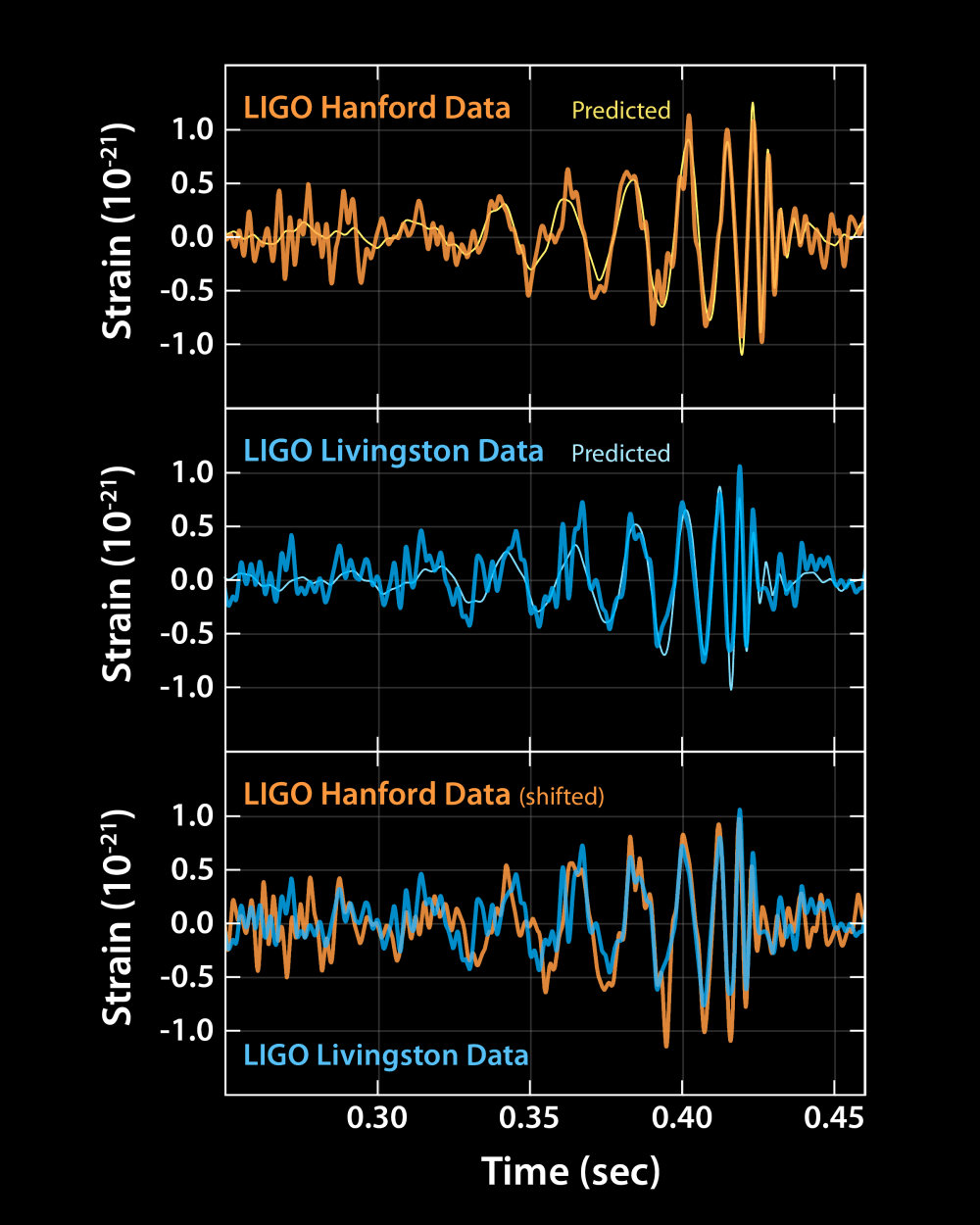
- The signal, GW150914, was recorded by both LIGO detectors on 14 September 2015 and is named for that date[2]
- Its waveform matched general relativity's prediction for the inspiral and merger of two black holes of 36 and 29 solar masses, and the ringdown of the 62 solar mass remnant[2][3]
- It was also the first observation of a binary black hole merger, showing both that binary stellar-mass black hole systems exist and that such mergers happen within the current age of the universe[2]
- Gravitational waves had previously been inferred only indirectly, through their effect on the timing of pulsars in binary star systems, after more than fifty years of attempts to detect them directly[2]
References 388% CONFIDENCE
The first entry is always the pin's source. Overall confidence is a weighted average of how firmly each reference supports the start and end times used above; a reference counts half as much for every 180 days older than the newest.
- [1]90%ligo.caltech.edu/news/ligo20160211ligo.caltech.edu· Posted Sep 22, 2026· Starts Feb 11, 2016 ✓· 33% of score
Wikipedia[2] dates both the observation and the announcement: "The first direct observation of gravitational waves was made on 14 September 2015 and was announced by the LIGO[3] and Virgo collaborations on 11 February 2016." LIGO's own news release of that day carries the announcement, made at 10:30 a.m. Eastern at the National Press Club, where this pin is placed.
- [2]90%First observation of gravitational wavesen.wikipedia.org· Added Sep 22, 2026· 33% of score
Gives the observation and announcement dates, the naming of GW150914 after the date of observation, the masses involved (36 and 29 solar masses merging to a 62 solar mass remnant) and that it was also the first observation of a binary black hole merger.[1]
- [3]85%GW150914 - LIGO Scientific Collaborationligo.org· Added Sep 22, 2026· 33% of score
The collaboration's own detection page for this event, the primary record of what was measured.[1]
Suggest a correction
Something missing or wrong? Say it in your own words: a link that backs this pin up, a different start or end date and why, or a fact it lacks or gets wrong. The AI checks it against this pin's sources, searches for better ones, and adds any page that backs you up. The pin's own sources still count most.


