
Der erste Eintrag ist immer die Quelle des Pins. Die Gesamtsicherheit ist ein gewichteter Durchschnitt, wie fest jeder Beleg die oben verwendeten Start- und Endzeiten stützt; ein Beleg zählt für je 180 Tage, die er älter ist als der neueste, nur halb so viel.
Google's own post, dated 18 November 2026, says Gemini 4 Neon is rolling out today.
Google DeepMind's model card linked from the announcement.[1]
Google's post on the safety and security approach for the Gemini 4 family, linked from the announcement.[1]
Google's announcement of the lower-cost sibling model released 12 November 2026.[1]
Google's post on the top-tier Gemini 4 Carbon model, the sibling above Neon.[1]
Fehlt etwas oder stimmt etwas nicht? Sag es in deinen eigenen Worten: ein Link, der diesen Pin belegt, ein anderes Start- oder Enddatum und warum, oder eine Angabe, die fehlt oder falsch ist. Die KI prüft es an den Quellen dieses Pins, sucht nach besseren und ergänzt jede Seite, die dich bestätigt. Die eigenen Quellen des Pins zählen weiterhin am meisten. Auch Bilder sieht sich die KI an: Eines, das etwas anderes oder die Sache schlecht zeigt, wird nach hinten gestellt oder ersetzt.
Unofficial, from StatusGator. Uptime is the share of the window not marked down (529 min down, 5676 min degraded); it covers the whole service, not this version alone.
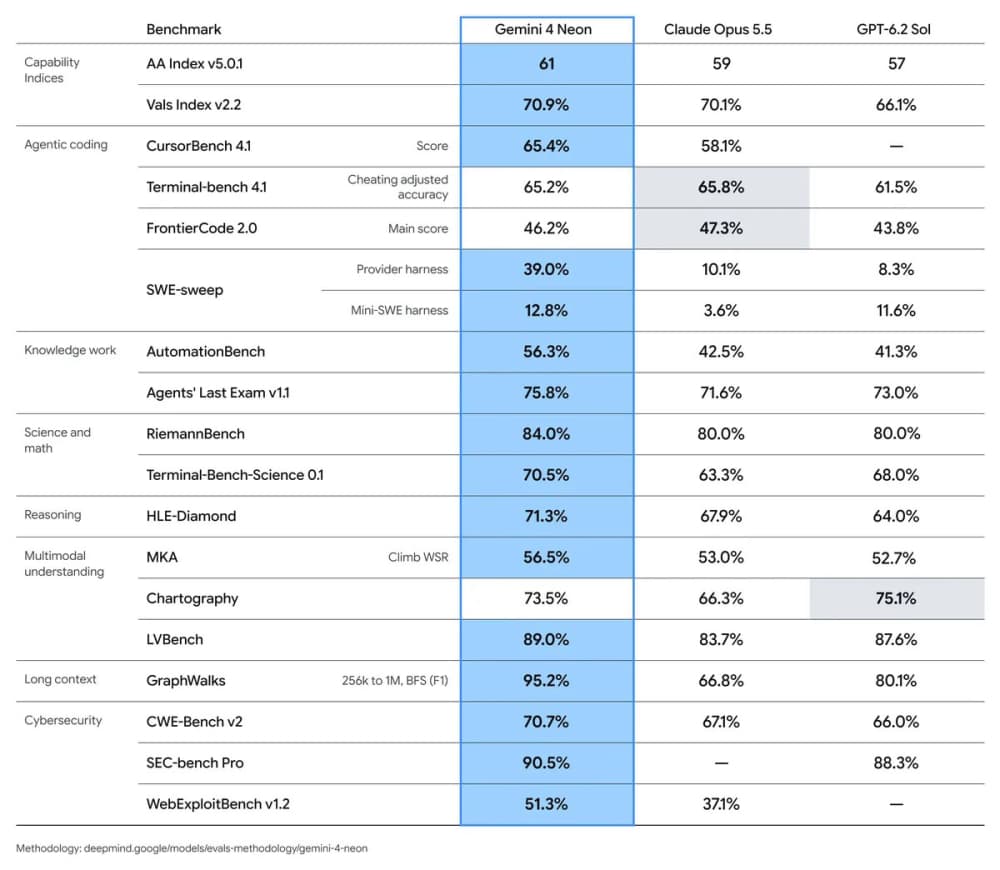
Google-reported launch comparison against Claude Opus 5.5 and GPT-6.2 Sol. A dash means Google published no figure for that model. These are the maker's own results, not independently checked here.[1]
| Benchmark (area) | Gemini 4 Neon | Claude Opus 5.5 | GPT-6.2 Sol |
|---|---|---|---|
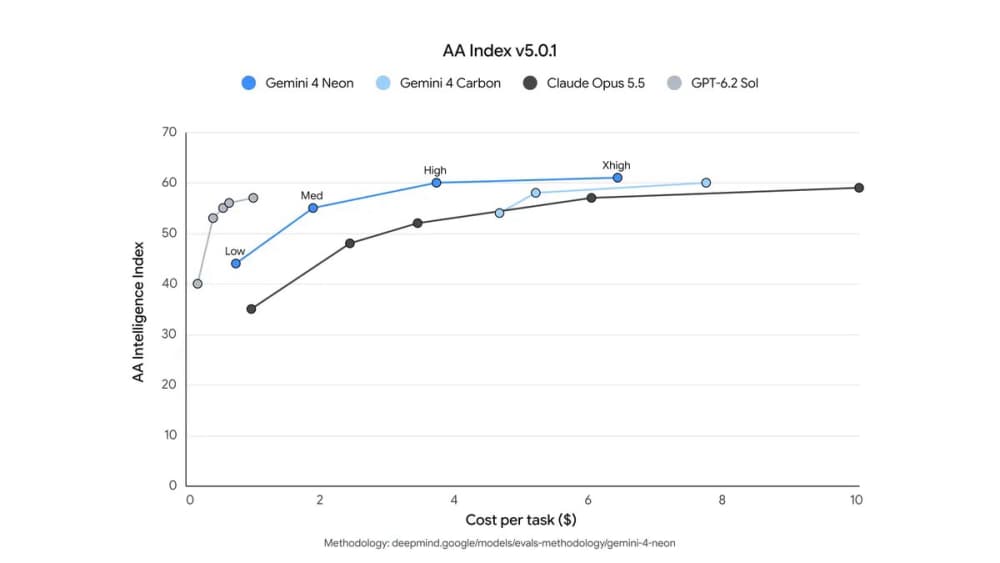
| AA Index v5.0.1 (Capability indices) | 61 | 59 | 57 |
| Vals Index v2.2 (Capability indices) | 70.9% | 70.1% | 66.1% |
| CursorBench 4.1 (score) (Agentic coding) | 65.4% | 58.1% | — |
| Terminal-bench 4.1 (cheating-adjusted accuracy) (Agentic coding) | 65.2% | 65.8% | 61.5% |
| FrontierCode 2.0 (main score) (Agentic coding) | 46.2% | 47.3% | 43.8% |
| SWE-sweep (provider harness) (Agentic coding) | 39.0% | 10.1% | 8.3% |
| SWE-sweep (Mini-SWE harness) (Agentic coding) | 12.8% | 3.6% | 11.6% |
| AutomationBench (Knowledge work) | 56.3% | 42.5% | 41.3% |
| Agents' Last Exam v1.1 (Knowledge work) | 75.8% | 71.6% | 73.0% |
| RiemannBench (Science and math) | 84.0% | 80.0% | 80.0% |
| Terminal-Bench-Science 0.1 (Science and math) | 70.5% | 63.3% | 68.0% |
| HLE-Diamond (Reasoning) | 71.3% | 67.9% | 64.0% |
| MKA (Climb WSR) (Multimodal understanding) | 56.5% | 53.0% | 52.7% |
| Chartography (Multimodal understanding) | 73.5% | 66.3% | 75.1% |
| LVBench (Multimodal understanding) | 89.0% | 83.7% | 87.6% |
| GraphWalks (256k to 1M, BFS F1) (Long context) | 95.2% | 66.8% | 80.1% |
| CWE-Bench v2 (Cybersecurity) | 70.7% | 67.1% | 66.0% |
| SEC-bench Pro (Cybersecurity) | 90.5% | — | 88.3% |
| WebExploitBench v1.2 (Cybersecurity) | 51.3% | 37.1% | — |
Neon leads on most rows, but Claude Opus 5.5 is ahead on Terminal-bench 4.1 (65.8% against 65.2%) and FrontierCode 2.0 (47.3% against 46.2%), and GPT-6.2 Sol is ahead on Chartography (75.1% against 73.5%). Google's methodology page is deepmind.google/models/evals-methodology/gemini-4-neon.[1]