- Start
- Jul 31, 194850% CONFIDENCEfrom the source
Shannon Publishes A Mathematical Theory of Communication
- "A Mathematical Theory of Communication" ran in the Bell System Technical Journal, volume 27, pages 379-423 and 623-656, in July and October 1948[1][2]
- The paper opens by noting that "the recent development of various methods of modulation such as PCM and PPM which exchange bandwidth for signal-to-noise ratio has intensified the interest in a general theory of communication", extending the earlier work of Nyquist and Hartley to include the effect of noise[1]
- It gave rise to the field of information theory and has tens of thousands of citations[2]
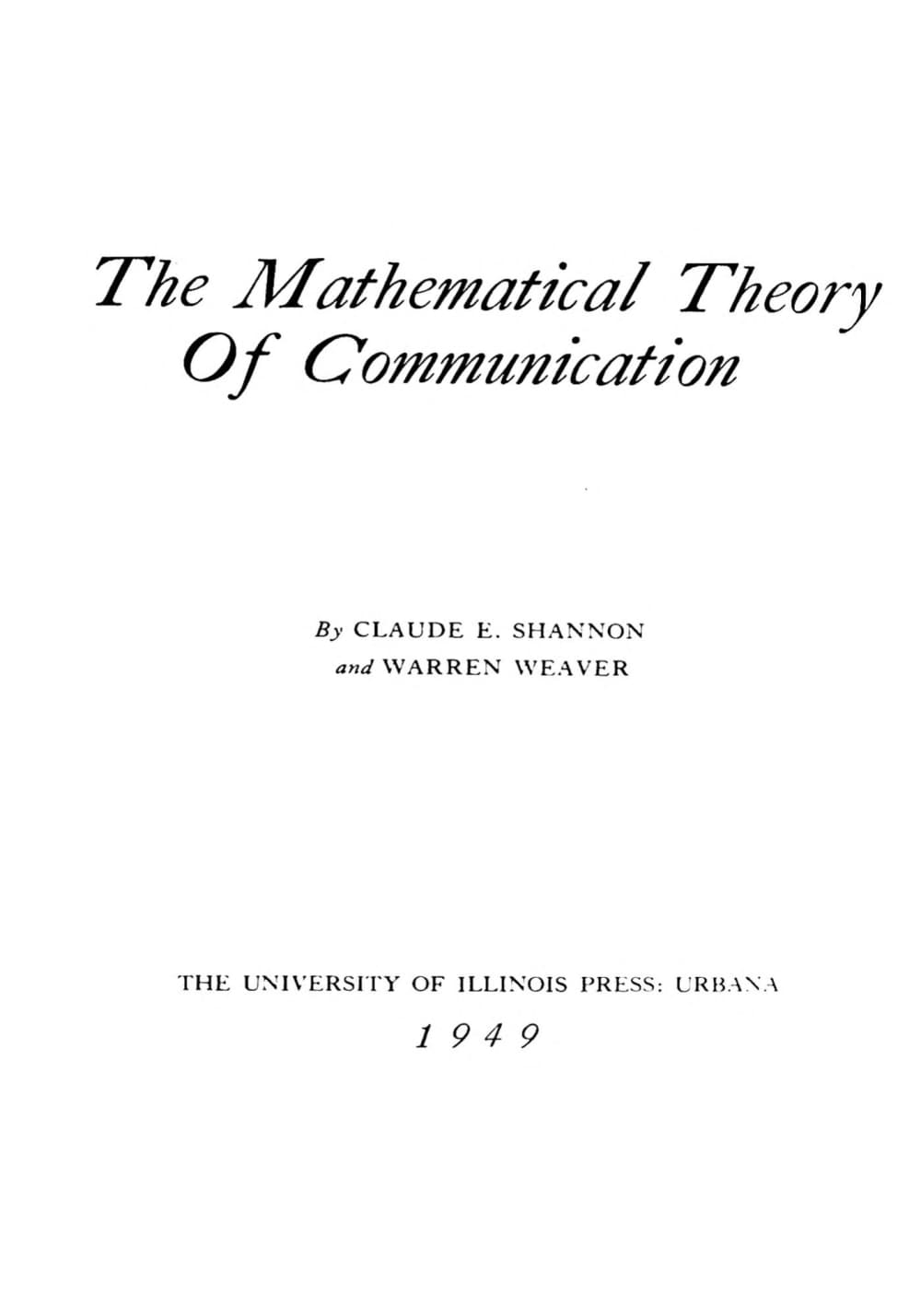
- It was republished in 1949 as a book, retitled The Mathematical Theory of Communication - "a small but significant title change after realizing the generality of this work"[2]
References 375% CONFIDENCE
The first entry is always the pin's source. Overall confidence is a weighted average of how firmly each reference supports the start and end times used above; a reference counts half as much for every 180 days older than the newest.
- [1]50%people.math.harvard.edu/~ctm/home/text/others/shannon/entropy/entropy.pdfpeople.math.harvard.edu· Posted Sep 22, 2026· Starts Jul 31, 1948 ✓· 33% of score
The paper's own reprint header gives the issue and no day: "Reprinted with corrections from The Bell System Technical Journal, Vol. 27, pp. 379-423, 623-656, July, October, 1948." It ran in two parts, July and October; a month with no day is estimated at that month's last day, so the pin sits at the end of July 1948, the first part.
- [2]90%A Mathematical Theory of Communicationen.wikipedia.org· Added Sep 22, 2026· 33% of score
Gives the journal and year and the paper's standing: "one of the most influential and cited scientific papers of all time, as it gave rise to the field of information theory", and the 1949 book retitling from A to The Mathematical Theory of Communication.[1]
- [3]85%Claude Shannonen.wikipedia.org· Added Sep 22, 2026· 33% of score
The author's article, for his position at Bell Labs and his earlier 1937 master's thesis applying Boolean algebra to switching circuits.[1]
Suggest a correction
Something missing or wrong? Say it in your own words: a link that backs this pin up, a different start or end date and why, or a fact it lacks or gets wrong. The AI checks it against this pin's sources, searches for better ones, and adds any page that backs you up. The pin's own sources still count most.


